Told you have a mass on your kidney?
Most kidney tumours are found early, by chance, and most are curable. Here is what happens next, and how we treat them.

Most kidney tumours are found early, by chance, and most are curable. Here is what happens next, and how we treat them.
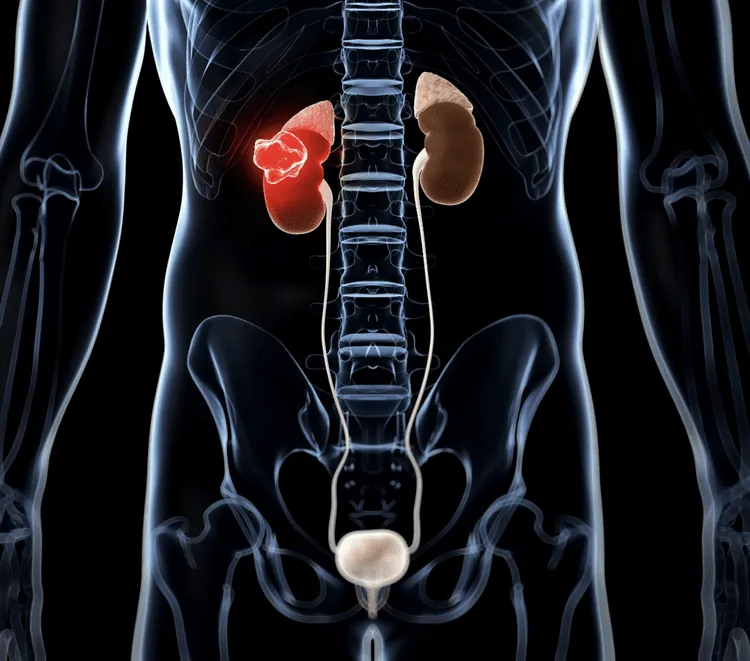
Most kidney tumours we see were discovered by accident. A patient has an ultrasound or CT scan for something unrelated, such as back pain, a gallbladder problem, or a check for kidney stones, and the report mentions a mass on the kidney.
That is unsettling to read. But it also means the tumour is usually found early, while it is small and has not spread. Small kidney tumours are among the most treatable cancers we manage, and many patients go on to a full, normal life with their kidney function intact.
Some kidney tumours do cause symptoms: blood in the urine, a dull ache in the side or back, or an unexplained lump. If you have any of these, see your family doctor. These symptoms are more often caused by something other than cancer, but they should be checked.
Not always, but usually. About 8 in 10 solid kidney masses are a cancer called renal cell carcinoma (RCC). The rest are benign growths, most often an oncocytoma or an angiomyolipoma, which look similar on a scan but are not cancer.
Cysts are different. Simple fluid-filled cysts are very common, especially after age 50, and are harmless. Some cysts have thicker walls or solid parts and are graded on a scale (the Bosniak classification) that tells us how closely they need to be watched. If your report mentions a Bosniak grade, we will explain exactly what it means for you.
Do I need a biopsy? Often not. For most solid masses, imaging gives us enough information to recommend treatment, and a biopsy would not change the plan. We do recommend a biopsy in selected cases, for example when the result would decide between surveillance and surgery, or when a tumour looks unusual. We will tell you if a biopsy makes sense in your situation and why.
Your family doctor or specialist sends a referral with your imaging report to your urologist's office. Your urologist reviews the images before you arrive.
At your consultation your urologist will:
What to bring: your imaging report, a CD or the name of the imaging clinic so the pictures can be accessed, your current medication list, and a list of your questions. Bring a family member if you would like a second set of ears.
The right treatment depends on the size and location of the tumour, your age and overall health, and how well your kidneys work. Surgery is the most common treatment, but it is not the only one, and for some patients it is not the best one.
Your urologist will tell you which of these apply to you and which they would recommend. If you are a candidate for surveillance, they will say so. Operating on every small tumour is not good care.
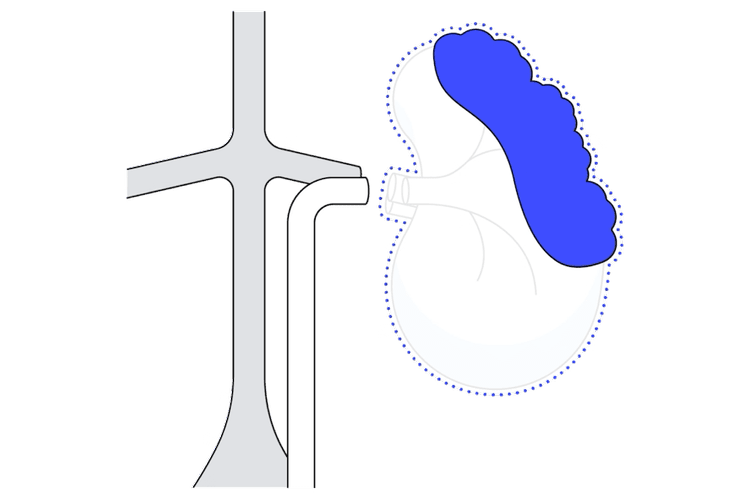
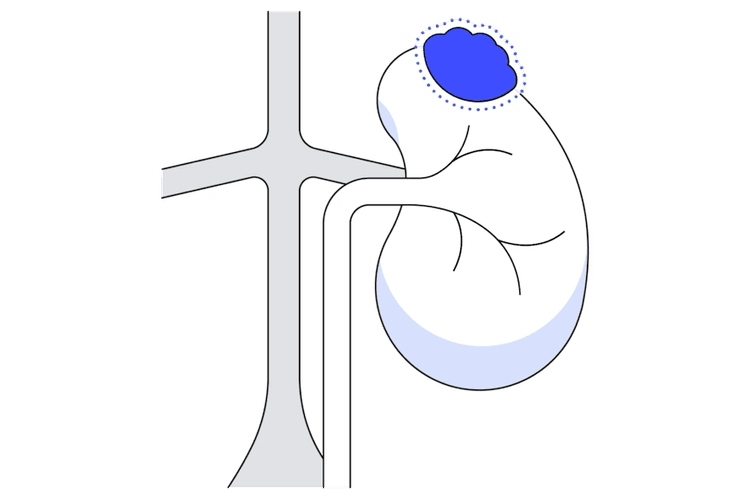
Nephrectomy is surgery to remove a kidney. Most commonly it treats kidney cancer, but it can also be used for other kidney conditions or injury. It can be done with traditional open surgery or laparoscopically, which is less invasive and allows a faster recovery.
In a radical nephrectomy, the entire kidney, and sometimes nearby tissues like the adrenal gland and lymph nodes, are removed. In a partial nephrectomy, only the tumour and a small amount of healthy tissue are taken out. This is often preferred when possible, as it helps preserve kidney function. Partial nephrectomy is also called "kidney-sparing" or "nephron-sparing" surgery.
Most kidney surgery is now done through a few small incisions, using a camera and fine instruments, rather than through a large open cut. This is called minimally invasive or laparoscopic surgery. It means less pain, less blood loss, a lower risk of wound infection, a shorter hospital stay, smaller scars, and a faster return to work and normal life.
Minimally invasive kidney surgery is a technique, and techniques are only as good as the hands that perform them. Dr. Klinghoffer has performed laparoscopic kidney surgery for [X] years and [X] cases, and does the demanding version of it, partial nephrectomy, routinely. His outcomes are published below.
Whenever a tumour can be removed while leaving the rest of the kidney in place, that is the goal. Keeping as much kidney as possible protects you against kidney disease, high blood pressure, and cardiovascular problems years down the road. Partial nephrectomy is technically harder than removing the whole kidney, and doing it minimally invasively is harder still. That is why the share of small tumours treated with partial nephrectomy, and the share completed without converting to open surgery, are two of the clearest measures of a kidney surgery program.
A small number of very large or complex tumours are still best treated with an open operation, and your surgeon will tell you plainly if that is the case for you. The goal is always the safest complete removal of the cancer, with the operation chosen to fit the tumour rather than the other way round.
There is more than one way to perform minimally invasive kidney surgery, and more than one kind of instrument. None of that matters as much as the results a surgeon actually delivers. Before you have kidney surgery anywhere, ask:
Laparoscopic partial nephrectomy, March 2024 to March 2025
Cases performed by Dr. Zachary Klinghoffer at Scarborough Health Network. n = [X] partial nephrectomies.
In hospital. Most partial nephrectomy patients go home the day after surgery. You will be up and walking the same evening. Pain is managed with regular acetaminophen and anti-inflammatories; most people need little or no opioid medication after the first day.
The first two weeks. Expect to feel tired and to have some soreness around the incisions. You can shower from day two, walk as much as you like, and climb stairs. No lifting more than 10 lb (a full kettle) and no driving while you are taking any opioid pain medication.
Weeks two to six. Most people return to desk work within two weeks and to physical work or exercise by four to six weeks.
Living with one kidney, or part of one. A single healthy kidney does the work of two. After a partial nephrectomy your kidney function usually returns to close to what it was before. Your creatinine and blood pressure are checked at follow-up, and your family doctor is asked to keep an eye on both over the years.
Follow-up. The pathology report takes about two weeks and gives the type and stage of the tumour. Based on that, your urologist sets a surveillance schedule, usually a CT or ultrasound at 6 months and then yearly for several years. The chance of the cancer coming back after removal of a small tumour is low, and follow-up imaging is how the rare case is caught early.
Will my family need screening? Rarely. Most kidney cancer is not inherited. Your urologist will tell you if your age, tumour type, or family history suggests a genetic cause, and refer you for genetic counselling if so.
Small kidney tumours grow slowly, typically a few millimetres a year. A consultation within a few weeks is appropriate; a wait of that length does not change the outcome. Large tumours or symptoms such as heavy bleeding are seen faster.
Yes. Consultation, imaging, surgery, hospital stay, and follow-up are all covered. There is no charge to you.
Almost never. Removing a tumour, or even an entire kidney, leaves more than enough kidney function for a normal life in the vast majority of patients. If your kidney function is already reduced, your urologist will discuss this with you and may involve a nephrologist.
Of course. Ask your family doctor to refer you, and make sure your imaging is available.
At Scarborough Health Network, Centenary site, a short walk from our office in the Medical Mall.
The urologist you are referred to. You will meet your surgeon at your consultation.
Yes. There is nothing you need to stop doing while a plan is made. Keep taking your usual medications unless your urologist tells you otherwise.
Ask your family doctor or specialist to refer you to one of the urologists below. We see patients from across Scarborough, Durham and the Greater Toronto Area.
Fax the referral to the office of the urologist you choose. Please include the imaging report, the name of the imaging facility, recent creatinine/eGFR, and the medication list. Mark the referral urgent for a mass over 7 cm, visible hematuria, or suspected metastatic disease.
Further reading: Kidney Cancer Canada, patient information and support in Canada; Canadian Cancer Society: kidney cancer, a plain-language overview.